How ReactJS Development Services Help Build Scalable Web Apps
ReactJS project pricing can change based on app features, frontend complexity, API integrations, team model, and the use of AI-assisted development tools. A clear cost breakdown helps business owners


A business website or web app is not only a digital presence today. It often works as a sales tool, customer support channel, booking system, dashboard, or business management platform. When more users start visiting the app, the system must stay fast, easy to use, and ready for new features.
As a web app grows, its frontend often needs a stronger structure to handle new features, users, and business workflows. Their web app works well in the beginning, but it becomes slow or hard to manage when the business grows. New pages, user roles, reports, payment systems, and third-party tools can make the app complex over time.
This is where ReactJS development services help. ReactJS allows developers to build scalable web applications with a clean frontend structure, reusable components, and responsive layouts. For business owners, this means better user experience, easier future updates, and a web app that can grow with business needs.
How ReactJS Web Development Supports Business Growth

ReactJS introduced a component-based architecture that changed how developers think about building interfaces. Instead of building a monolithic page, everything gets broken into reusable, independently testable components. This approach directly supports scalability because individual parts of the application can be updated, replaced, or extended without touching the rest of the codebase.
The Virtual DOM is another technical advantage that matters at scale. ReactJS calculates the minimum number of DOM updates needed and batches them efficiently, which means your app stays fast even as content volume and user interactions grow.
This helps businesses with:
Faster page loads with less client-side re-rendering overhead
Consistent UI across complex, multi-page applications
Reduced regression risk when adding new features
Lower maintenance cost over time due to modular code
These aren’t theoretical benefits. They show up in real projects when teams build dashboards, SaaS platforms, ecommerce frontends, and content-heavy portals with ReactJS.
Related Guide: How Much Does React.js Website Development Cost?
Key Services Included in ReactJS Web Development
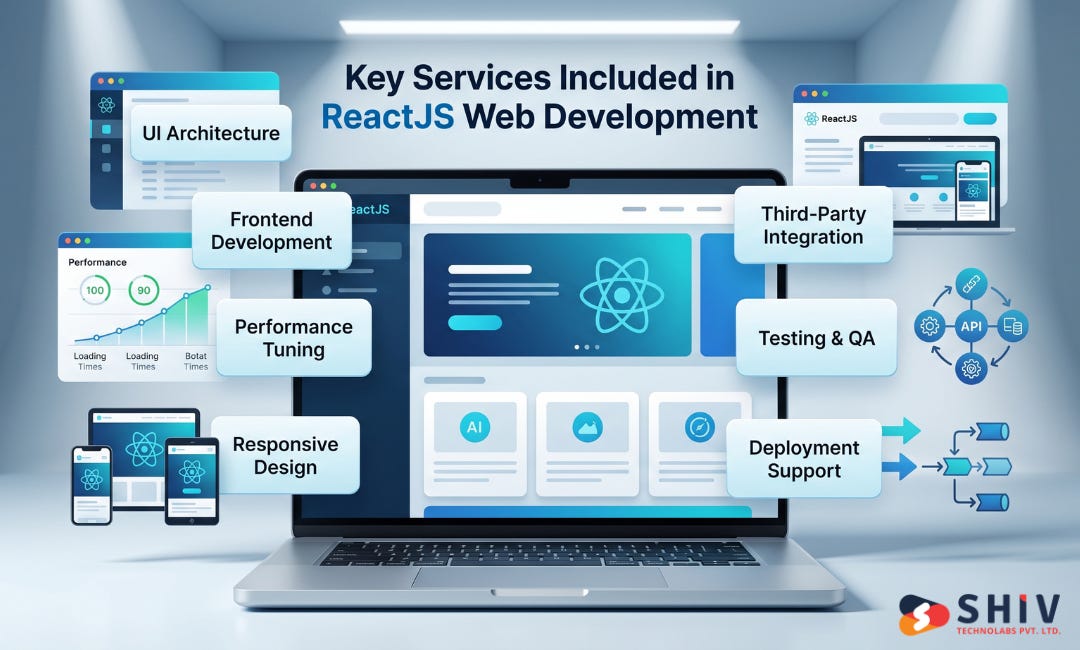
When you work with a ReactJS development company, the engagement typically includes much more than writing JSX. Here’s what a well-scoped ReactJS web development services package looks like:
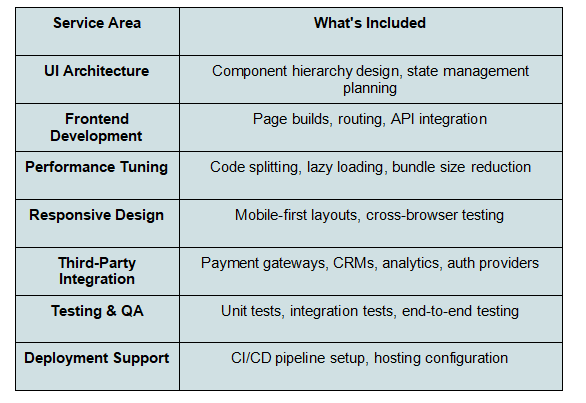
Custom ReactJS development services go beyond this standard list when the project requires unique functionality, such as real-time data visualization, offline-first apps, or complex role-based access systems.
Key ReactJS Features for Scalable Frontend Development
ReactJS gives developers a flexible frontend structure that supports reusable components, better data handling, SEO-friendly rendering, and responsive layouts. These features help business web apps stay fast, easy to manage, and ready for future growth.
Component Reusability
Well-built React components are self-contained. A button, modal, form field, or data table built once can be reused across hundreds of screens without duplication. This saves development time and keeps the visual language consistent.
State Management at Scale
For large applications, managing state across dozens of components gets complicated quickly. ReactJS integrates cleanly with libraries like Redux Toolkit, Zustand, and React Query, each suited to different complexity levels. The right choice depends on your data flow requirements, and a good ReactJS development company will make that architectural decision early.
ReactJS Frontend Development and SEO
A common concern with JavaScript-heavy frontends is search engine visibility. ReactJS addresses this through server-side rendering (SSR) with Next.js, which pre-renders pages on the server so search engines can crawl them properly. This is particularly important for ecommerce and content-driven applications where organic traffic matters.
Responsive Web Applications
Modern users switch between devices constantly. ReactJS, when paired with CSS frameworks like Tailwind or Material UI, makes building truly responsive web applications straightforward. The component structure allows developers to apply conditional rendering and layout adjustments cleanly without redundant code.
ReactJS Development Cost and Timeline for Business Owners
Pricing for ReactJS development services depends on project size, feature complexity, design needs, API integrations, team experience, and delivery model. In the AI era, many development teams use AI-assisted coding, ready UI libraries, reusable components, and faster testing workflows. This can reduce development time for standard features and help businesses plan a smarter budget.
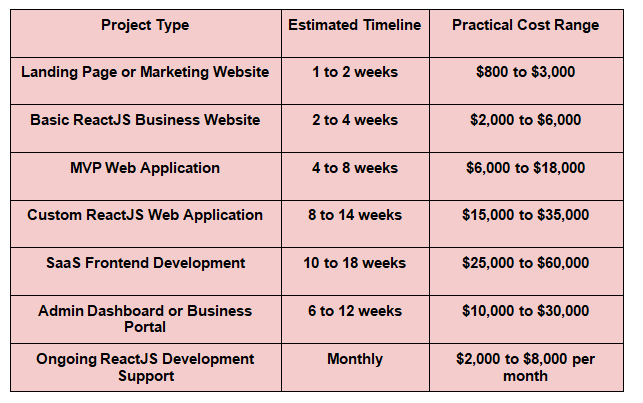
These are general budget ranges, not fixed prices. A simple ReactJS website with basic pages costs less, while a custom web app with user roles, a payment gateway, a dashboard, reporting, API integrations, and advanced workflows needs a higher budget. AI-assisted development can reduce repeated work, but expert planning, clean code, testing, security, and frontend architecture still need skilled developers.
More Insights: How ReactJS Development Improves Front-End Performance
Common Mistakes Businesses Make With ReactJS Projects
Even with a solid library, projects can go wrong. The most common issues include:
Skipping architecture planning: Teams that jump straight into component building without mapping the data flow end up with prop-drilling problems and unmaintainable code within a few months.
Overcomplicating state management: Adding Redux to a small or medium application that could work fine with React Context and local state adds unnecessary complexity.
Ignoring performance budgets: Shipping large, unoptimized bundles slows down initial load time. Code splitting and lazy loading need to be part of the build from the start, not retrofitted later.
Treating ReactJS as a full-stack solution: ReactJS handles the frontend. It still needs a properly structured backend API, hosting infrastructure, and database layer to function as a complete application.
Why Choose Shiv Technolabs as Your ReactJS Development Partner
Shiv Technolabs offers ReactJS development services for businesses that want fast, scalable, and responsive web applications. Our team builds modern web apps using ReactJS frontend libraries, reusable UI components, JavaScript fundamentals, and ECMA skills. With strong ReactJS experience, we help startups and growing companies create web apps that are easy to manage, simple to update, and ready for future business growth.
From custom ReactJS development services to API integration, frontend architecture, and responsive UI development, our developers work on each part of the project with a business-first approach. Whether you need a SaaS platform, dashboard, customer portal, or custom web application, our team can help you build a ReactJS solution that supports a better user experience and long-term scalability.
We can help you build a ReactJS solution that supports a better user experience and long-term scalability. Contact us to discuss your ReactJS project.
Conclusion
ReactJS is the right choice for building scalable, responsive web applications, but the technical outcome depends heavily on how the project is structured and who builds it. Component architecture, state management decisions, performance practices, and testing all determine whether the application grows cleanly or becomes a maintenance problem.
Businesses that invest in proper ReactJS development services from the beginning spend less time fixing issues later and more time shipping features that actually move the product forward.
Frequently Asked Questions
1. When should a business choose ReactJS for web app development?
A business should choose ReactJS when it needs a fast, interactive, and scalable frontend. It works well for dashboards, SaaS platforms, customer portals, eCommerce interfaces, booking systems, and data-driven web apps. ReactJS also helps when the app needs regular feature updates because its component-based structure keeps development more manageable.
2. Can ReactJS handle high-traffic web applications?
Yes, ReactJS can support high-traffic web applications when developers plan the frontend architecture properly. React is built around reusable UI components, which makes it suitable for large user interfaces and growing products. For high-traffic apps, developers also need proper code splitting, API handling, caching, testing, and backend support.
3. Is ReactJS better for startups or enterprise web apps?
ReactJS can work well for both startups and enterprises. Startups can use ReactJS to build MVPs, SaaS products, and customer-facing web apps faster. Enterprises can use it for complex dashboards, internal tools, portals, and large frontend systems that need strong structure and long-term maintenance.
4. What type of web apps can be built with ReactJS development services?
ReactJS development services can be used to build SaaS applications, admin dashboards, CRM systems, eCommerce frontends, healthcare portals, fintech dashboards, booking platforms, learning management systems, and custom business web apps. It is a strong choice when the app needs dynamic screens, user actions, and frequent updates.
5. Does ReactJS help improve web app speed and user experience?
ReactJS can improve web app speed and user experience when used with the right development practices. Developers can build reusable components, reduce repeated page loading, manage UI updates better, and create faster screen interactions. This helps users move through the app with less delay and a cleaner experience.
6. What should I ask before hiring a ReactJS development company?
Before hiring a ReactJS development company, ask about their past ReactJS projects, frontend architecture process, API integration experience, responsive design work, testing method, and post-launch support. You should also ask how they plan scalability, performance, and future feature additions for your web app.